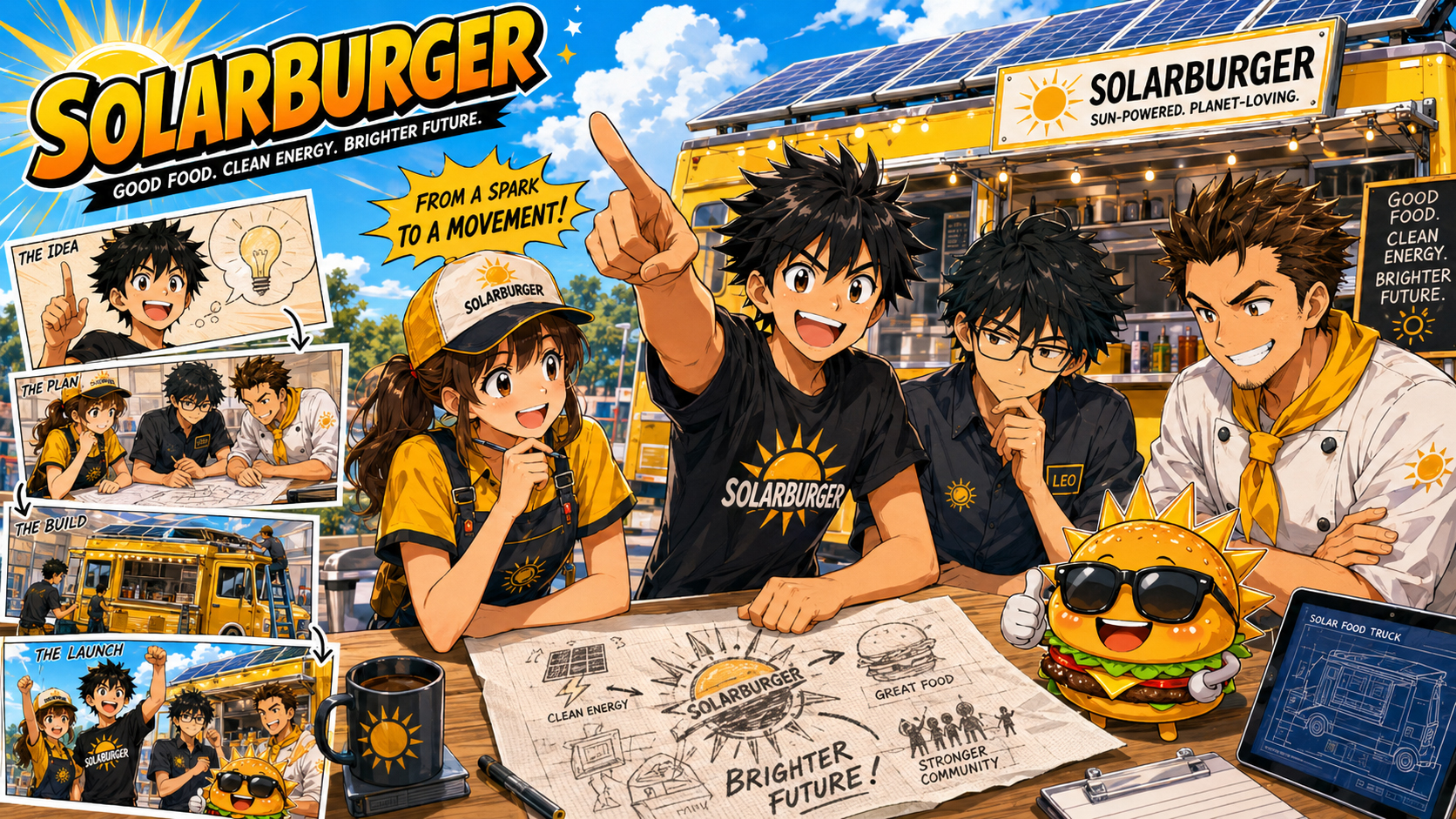
Chapter Zero
The Solarburger Story
It started as a joke. Then it became a sketch. Then the sketch became a pitch deck. And once there was a pitch deck, everyone was in trouble.
The founder’s impossible lunch
The founder was sitting outside with a burger in one hand and a solar calculator in the other. The calculator worked perfectly in the sun. The burger, sadly, was cold. Most people would have solved this by finding a microwave. The founder saw a global opportunity.
He grabbed a napkin and wrote the first Solarburger business plan: “The world’s first sun-powered burger chain.” Under that, he drew a smiling burger wearing sunglasses. Under that, he wrote: “Good Burgers. Good Energy.”
“This is not a restaurant idea,” he announced. “This is a solar revolution with pickles.”
The team forms
The engineer was the first person foolish enough to listen carefully. He asked normal engineering questions: how hot, how long, how many burgers per hour, what happens in winter, what happens under clouds, what happens at night, and whether the founder understood that restaurants cannot close every time a shadow appears.
The founder answered with confidence, which is not the same thing as data.
The operator joined because she recognized the dangerous smell of an idea that might get funded. She brought a clipboard, a calendar, a permit checklist, and the expression of someone who already knew she would be cleaning up the mess.
The chef joined last. He said one thing:
“If the burger tastes like a science project, I quit.”
The first prototype
The first Solarburger grill was built from optimism, reflective metal, solar panels, wires, a battery, one borrowed table, and a number of parts nobody wanted to explain to the inspector. At noon, the sun hit the reflector. The grill warmed. The patty sizzled. The team screamed.
For seven glorious minutes, the future of fast food seemed obvious.
Then a cloud arrived.
The patty stopped sizzling. The founder stared at the sky like a betrayed business partner. The engineer quietly opened a spreadsheet. The operator wrote: Problem #1: weather has opinions.
The melted spatula incident
The founder did not like slow cooking. The engineer did not like vague complaints. So the team increased reflector concentration. The next test produced heat, confidence, smoke, panic, and the legendary melted spatula.
The chef held up the wounded utensil like evidence in court.
“You have not built a restaurant,” he said. “You have built a sun cannon aimed at lunch.”
The founder called it proof of concept. The operator called it proof of insurance.
The night problem
The next crisis came from a customer who was not even trying to be difficult. He simply asked, “Can I get a Solarburger for dinner?”
Nobody spoke.
That question changed the company. Solarburger could not just be a gimmick that worked at noon in perfect weather. It needed batteries. It needed thermal strategy. It needed backup cooking logic. It needed refrigeration, lights, point-of-sale equipment, and a plan that survived sunset.
The engineer finally smiled.
“Now,” he said, “we are building a real system.”
The pitch room
The investors loved the logo. They loved the manga energy. They loved the words “renewable fast food.” They loved the idea of a chain that could turn sunlight into lunch and social media into customers.
Then they asked the fatal question:
“How many burgers per hour?”
The founder said, “In full sun or emotionally?”
The operator stepped on his foot under the table.
The food truck test
The team decided the first real Solarburger should be mobile. A food truck could test the brand, prove the cooking concept, show off the solar panels, and run a smaller version of the restaurant system.
The truck looked beautiful. Solar panels on top. Bright signage. A solar cooking setup. Batteries inside. A burger logo smiling like it knew something the accountants did not.
On launch day, the line formed quickly. The sun was perfect. The burgers were ready. The founder almost cried.
Then the inspector arrived.
Permit me to cook
City Hall had questions. Many questions.
Was Solarburger a restaurant? Yes. Was it a power system? Also yes. Was it a food truck? Sometimes. Was it a solar demonstration? Technically. Was it dangerous? The chef pointed at the founder and said, “Only him.”
The permit process became its own saga. Forms were filed. Diagrams were redrawn. The operator became a legend in the waiting room. The engineer learned to explain solar cooking in sentences that did not cause fear. The founder was told to stop using the phrase “sun cannon.”
The first real Solarburger
After the setbacks, the team finally served the first real Solarburger: properly cooked, juicy, hot, balanced, and strangely memorable.
Everyone expected a gimmick. They got a burger.
The chef took one bite, looked at the grill, looked at the sky, and said:
“The sun has flavor.”
That was the moment Solarburger stopped being only a joke.
The mascot appears
Sunny Patty began as a logo. A cheerful sun-burger face. Good for stickers, shirts, flags, and boxes. Then the founder started talking to it during late nights at the office.
Sunny Patty’s advice was never practical, but always enthusiastic:
“Never fear the cloud. Outsizzle it.”
The operator refused to acknowledge that the mascot was part of management. The investors loved him immediately.
Grand opening
One year after the napkin sketch, the first Solarburger opened. The sign was bright. The grill was ready. The battery system was charged. The chef had backup spatulas. The operator had backup plans. The engineer had backup backups.
The line went around the block.
Halfway through the rush, a giant cloud moved across the sun. The founder froze. The crowd looked up. The chef looked at the grill.
Then the battery system kicked in.
The grill stayed hot. The lights stayed on. The orders kept moving. The team cheered. The customers cheered. Sunny Patty appeared on the sign, smiling like he had planned the whole thing.
Good Burgers. Good Energy.
What the story is really about
Solarburger is a comedy about a ridiculous business idea. But underneath the joke is a real idea: clean energy should be visible, useful, fun, and part of ordinary life.
The story turns solar power into something people can smell, taste, laugh at, and remember. It is about startups, restaurants, invention, failure, branding, engineering, and the moment when a crazy idea becomes just real enough to keep going.
It is not just a burger chain. It is a manga business fable about heat, hustle, hamburgers, and the stubborn belief that the future should be delicious.